Voting for Department of Education Video Contest Begins
Posted by Eddie Lee on November 17, 2009 at 04:52 PM EST
Since September 21st, hundreds of students across the country responded to the President’s call to take greater responsibility for their education by creating videos explaining why education is important. In less than two months, students submitted more than 600 video entries.
In their entries, students talked about the goals they had for their future and the steps they would take to meet them. The submissions came from students from diverse economic, social and ethnic backgrounds, and the content ranged from music videos to short skits. The common theme in all of these videos was the understanding that education was the key to success.
Secretary Arne Duncan recorded a message thanking all the students who submitted videos:
The U.S. Department of Education’s Office of Communications and Outreach has carefully reviewed each submission and narrowed the submissions down to 10 finalists based on creativity, strength and originality of content, and ability to inspire. These videos are now available for voting at www.youtube.com/Iamwhatilearn.
Voting for the videos runs from November 16th to December 4th. The three videos with the most votes at the end of this period will each win a $1,000 prize issued by the U.S. Department of Education.
Eddie Lee is Director of New Media at the Department of Education
Tuesday, November 17, 2009

The US and China: Towards a Clean Energy Economy
The US and China: Towards a Clean Energy Economy
Posted by Jesse Lee on November 17, 2009 at 02:13 PM EST
After a warm welcome in Beijing's historic Great Hall of the People, President Obama and President Hu sat down to discuss the many overlapping issues facing both nations, including China's growing economy and its effect on the US and the rest of the world and the exciting education reforms happening in each country:
PRESIDENT OBAMA: As we both affirmed, the United States and China have a great many mutual interests. And after 30 years of bilateral relations, I think it's fair to say that our two governments have continued to move forward in a way that can bring even greater cooperation in the future.
And I want to reaffirm the fact that the American people are interested in stronger relations with the people of China, and that the more that we can encourage people-to-people exchanges that are consistent with the discussions that we're having at the government level, the more that China and the United States will be able to work cooperatively on a whole range of issues -- both economic issues, security issues, and global issues that are in the interest not just of our two nations but the entire world.

President Barack Obama and Chinese President Hu Jintao speak during a joint press conference held at the Great Hall of the People in Beijing, China, Nov 17, 2009. (Official White House Photo by Lawrence Jackson)
.One topic of particular interest to both leaders is a joint initiative towards clean energy, and President Obama and President Hu introduced a far-reaching package of measures to strengthen cooperation between the United States and China on clean energy. An abridged version of the measures is below, and the full version is available here:
The U.S.-China Clean Energy Research Center will facilitate joint research and development of clean energy technologies by teams of scientists and engineers from the United States and China, as well as serve as a clearinghouse to help researchers in each country.
The U.S.-China Electric Vehicles Initiative will include joint standards development, demonstration projects in more than a dozen cities, technical roadmapping and public education projects, all aimed at eventual deployment of electric vehicles to reduce oil dependence.
The U.S. China Energy Efficiency Action Plan will allow the two countries to work together to improve the energy efficiency of buildings, industrial facilities, and consumer appliances, culminating with an annual U.S.-China Energy Efficiency Forum, rotating between the two countries.
The U.S. China Renewable Energy Partnership will facilitate development of roadmaps for wide-spread renewable energy deployment. A new Advanced Grid Working Group made up of American and Chinese developers and strategists will help plan for grid modernization in both countries, and a new U.S.-China Renewable Energy Forum will be held annually, rotating between the two countries.
A 21st Century Coal Initiative, for which the two Presidents pledged to promote cooperation on cleaner uses of coal, will include large-scale carbon capture and storage (CCS) demonstration projects.
A Shale Gas Initiative, will allow the U.S. and China to use experience gained in the United States to assess China’s shale gas potential, promote environmentally-sustainable development of shale gas resources, conduct joint technical studies to accelerate development of shale gas resources in China, and promote shale gas investment in China through the U.S.-China Oil and Gas Industry Forum, study tours, and workshops.
The U.S. China Energy Cooperation Program will leverage private sector resources for project development work in China across a broad array of clean energy projects, to the benefit of both nations.

President Barack Obama and President Hu Jintao together at a reception before the formal state dinner at Great Hall of the People in Beijing, China on Nov. 17, 2009. (Official White
Posted by Jesse Lee on November 17, 2009 at 02:13 PM EST
After a warm welcome in Beijing's historic Great Hall of the People, President Obama and President Hu sat down to discuss the many overlapping issues facing both nations, including China's growing economy and its effect on the US and the rest of the world and the exciting education reforms happening in each country:
PRESIDENT OBAMA: As we both affirmed, the United States and China have a great many mutual interests. And after 30 years of bilateral relations, I think it's fair to say that our two governments have continued to move forward in a way that can bring even greater cooperation in the future.
And I want to reaffirm the fact that the American people are interested in stronger relations with the people of China, and that the more that we can encourage people-to-people exchanges that are consistent with the discussions that we're having at the government level, the more that China and the United States will be able to work cooperatively on a whole range of issues -- both economic issues, security issues, and global issues that are in the interest not just of our two nations but the entire world.

President Barack Obama and Chinese President Hu Jintao speak during a joint press conference held at the Great Hall of the People in Beijing, China, Nov 17, 2009. (Official White House Photo by Lawrence Jackson)
.One topic of particular interest to both leaders is a joint initiative towards clean energy, and President Obama and President Hu introduced a far-reaching package of measures to strengthen cooperation between the United States and China on clean energy. An abridged version of the measures is below, and the full version is available here:
The U.S.-China Clean Energy Research Center will facilitate joint research and development of clean energy technologies by teams of scientists and engineers from the United States and China, as well as serve as a clearinghouse to help researchers in each country.
The U.S.-China Electric Vehicles Initiative will include joint standards development, demonstration projects in more than a dozen cities, technical roadmapping and public education projects, all aimed at eventual deployment of electric vehicles to reduce oil dependence.
The U.S. China Energy Efficiency Action Plan will allow the two countries to work together to improve the energy efficiency of buildings, industrial facilities, and consumer appliances, culminating with an annual U.S.-China Energy Efficiency Forum, rotating between the two countries.
The U.S. China Renewable Energy Partnership will facilitate development of roadmaps for wide-spread renewable energy deployment. A new Advanced Grid Working Group made up of American and Chinese developers and strategists will help plan for grid modernization in both countries, and a new U.S.-China Renewable Energy Forum will be held annually, rotating between the two countries.
A 21st Century Coal Initiative, for which the two Presidents pledged to promote cooperation on cleaner uses of coal, will include large-scale carbon capture and storage (CCS) demonstration projects.
A Shale Gas Initiative, will allow the U.S. and China to use experience gained in the United States to assess China’s shale gas potential, promote environmentally-sustainable development of shale gas resources, conduct joint technical studies to accelerate development of shale gas resources in China, and promote shale gas investment in China through the U.S.-China Oil and Gas Industry Forum, study tours, and workshops.
The U.S. China Energy Cooperation Program will leverage private sector resources for project development work in China across a broad array of clean energy projects, to the benefit of both nations.

President Barack Obama and President Hu Jintao together at a reception before the formal state dinner at Great Hall of the People in Beijing, China on Nov. 17, 2009. (Official White
China through the Lens of the White House Photographer
China through the Lens of the White House Photographer
Posted by Arun Chaudhary on November 17, 2009 at 01:51 PM EST
When dealing with official state visits, things come in pairs. The leaders hold joint press conferences. The limousines in the motorcades fly the flags of both nations on the hood. The staff sit in equal numbers at the table, each opposite his or her equivalent in the other country's delegation. Even the official photographers are paired together. Where one is allowed to go, the other will expect to follow.
For Pete Souza, director of the White House Photo Office (and my boss), it is a matter of professional courtesy and collegial camaraderie.
In this update Pete tells us some of the other trials and tribulations of shooting on the road. And he has one more surprising pair: though this is President Obama's first trip to China, it is Pete's second state visit. He was here as one of President Reagan's official photographers in 1984 and shared with us some of the differences he has noticed over the decades in this vibrant city.
He also shared some of the lens lengths he uses but don't be fooled, it takes more than a certain type of lens to capture a great photo.
Here are some pictures from the trip so far:

President Barack Obama, right, watches the entertainment with President Hu Jintao at a formal state dinner at Great Hall of the People in Beijing, China on Nov. 17, 2009. (Official White House photo by Pete Souza)
.

President Barack Obama shakes hands with the entertainers at a state dinner with President Hu Jintao at Great Hall of the People in Beijing, China on Nov. 17, 2009. (Official White House photo by Pete Souza)
.

President Barack Obama is escorted by officials as he tours the Forbidden City in Beijing, China, Nov. 17, 2009.
.

Chinese honor guards prepare for President Barack Obama's arrival at the Great Hall of the People in Beijing, China, Nov. 17, 2009. (Official White House Photo by Lawrence Jackson)
.
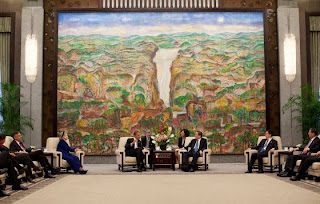
President Barack Obama meets with Shanghai Communist Party chief Yu Zhengsheng at the Xijiao State Guest House in Shanghai, Nov. 16, 2009. (Official White House photo by Pete Souza)
.

Secretary of State Hillary Clinton jokes with President Barack Obama about their headphones for translation after a bilateral meeting with President Medvedev of Russia in Singapore on Nov. 15, 2009. President Obama's headphones for translation weren't working properly and he had just received a new headset. (Official White House photo by Pete Souza)
.

President Barack Obama greets children of U.S. embassy workers in Tokyo, Japan, Nov. 14, 2009. (Official White House photo by Pete Souza)
.Arun Chaudhary is the official White House videographer
Posted by Arun Chaudhary on November 17, 2009 at 01:51 PM EST
When dealing with official state visits, things come in pairs. The leaders hold joint press conferences. The limousines in the motorcades fly the flags of both nations on the hood. The staff sit in equal numbers at the table, each opposite his or her equivalent in the other country's delegation. Even the official photographers are paired together. Where one is allowed to go, the other will expect to follow.
For Pete Souza, director of the White House Photo Office (and my boss), it is a matter of professional courtesy and collegial camaraderie.
In this update Pete tells us some of the other trials and tribulations of shooting on the road. And he has one more surprising pair: though this is President Obama's first trip to China, it is Pete's second state visit. He was here as one of President Reagan's official photographers in 1984 and shared with us some of the differences he has noticed over the decades in this vibrant city.
He also shared some of the lens lengths he uses but don't be fooled, it takes more than a certain type of lens to capture a great photo.
Here are some pictures from the trip so far:

President Barack Obama, right, watches the entertainment with President Hu Jintao at a formal state dinner at Great Hall of the People in Beijing, China on Nov. 17, 2009. (Official White House photo by Pete Souza)
.

President Barack Obama shakes hands with the entertainers at a state dinner with President Hu Jintao at Great Hall of the People in Beijing, China on Nov. 17, 2009. (Official White House photo by Pete Souza)
.

President Barack Obama is escorted by officials as he tours the Forbidden City in Beijing, China, Nov. 17, 2009.
.

Chinese honor guards prepare for President Barack Obama's arrival at the Great Hall of the People in Beijing, China, Nov. 17, 2009. (Official White House Photo by Lawrence Jackson)
.

President Barack Obama meets with Shanghai Communist Party chief Yu Zhengsheng at the Xijiao State Guest House in Shanghai, Nov. 16, 2009. (Official White House photo by Pete Souza)
.

Secretary of State Hillary Clinton jokes with President Barack Obama about their headphones for translation after a bilateral meeting with President Medvedev of Russia in Singapore on Nov. 15, 2009. President Obama's headphones for translation weren't working properly and he had just received a new headset. (Official White House photo by Pete Souza)
.

President Barack Obama greets children of U.S. embassy workers in Tokyo, Japan, Nov. 14, 2009. (Official White House photo by Pete Souza)
.Arun Chaudhary is the official White House videographer
Empowering U.S. Companies to Compete Abroad
Empowering U.S. Companies to Compete Abroad
Posted by Secretary Gary Locke and Ambassador Ronald Kirk on November 17, 2009 at 12:24 PM EST
It's been over a week since we first arrived in Asia. First, we traveled to the Asia Pacific Economic Cooperation (APEC) Summit in Singapore, and now we have joined President Obama in Beijing, China. We have come to this important region to engage our counterparts to strengthen our economic relationships, further open Asian markets to American exports and create well-paid jobs at home.
The 21 countries that make up APEC account for some 61 percent of American exports, and traveling today through the streets of Beijing, it's not hard to see why.
There's a frenetic pace in Asia's big cities, with construction cranes an ever present part of the cities' skylines.
This growth is good news for the people of Asia who have found exciting new opportunities in these cities. But it's also promising news for the workers, small businesspeople, ranchers and farmers of the United States, because selling our goods and services to these markets can put scores of Americans back to work and get our economy growing again.
And that is fundamentally why we are here this week. We're trying to open up markets for American products and ensure that our businesses are able to compete on a level playing field in the global economy.
During our time in Asia, we've been meeting with various ministers from Asian governments as well as representatives of the American business community like the U.S.-China Business Council and the American Chamber of Commerce in China.
We are also taking the opportunity on this trip to talk about recent trade disputes and how such disputes are ultimately a healthy part of a mature trading relationship.
The United States is the most open major economy in the world and the Administration is committed to ensuring our borders will remain open to the world’s products.
But that commitment will be met by a renewed focus on doing more to enable U.S. companies to compete in foreign markets.
Ultimately, that will be good for everyone. U.S. technology and know-how can be of great benefit to countries throughout Asia. For example, as countries like China strive to reach ambitious clean energy and efficiency targets, they will depend on expertise of U.S. firms with a proven record of success in these areas.
This year, we have already made great progress in creating a freer, fairer trade environment with Asia. When we were in China a few weeks ago, our Chinese ministerial counterparts pledged to open up their markets to U.S. wind turbine producers and lifted a needless non-science based ban on the import of U.S. pork.
They also promised significant strides towards protecting the intellectual property of American companies operating within their borders and steps to ensure a more level playing field in China’s government procurement market.
These are important steps that will be good both for the creation of America jobs and the continuance of Chinese growth. And we are seeking to build on the positive momentum this week.
As President Obama recently said "power in the 21st century is no longer a zero-sum game; one country's success need not come at the expense of another."
There is a lot to be gained from cooperation between Asia and the United States, and we are excited to be playing our part to move things forward.
Posted by Secretary Gary Locke and Ambassador Ronald Kirk on November 17, 2009 at 12:24 PM EST
It's been over a week since we first arrived in Asia. First, we traveled to the Asia Pacific Economic Cooperation (APEC) Summit in Singapore, and now we have joined President Obama in Beijing, China. We have come to this important region to engage our counterparts to strengthen our economic relationships, further open Asian markets to American exports and create well-paid jobs at home.
The 21 countries that make up APEC account for some 61 percent of American exports, and traveling today through the streets of Beijing, it's not hard to see why.
There's a frenetic pace in Asia's big cities, with construction cranes an ever present part of the cities' skylines.
This growth is good news for the people of Asia who have found exciting new opportunities in these cities. But it's also promising news for the workers, small businesspeople, ranchers and farmers of the United States, because selling our goods and services to these markets can put scores of Americans back to work and get our economy growing again.
And that is fundamentally why we are here this week. We're trying to open up markets for American products and ensure that our businesses are able to compete on a level playing field in the global economy.
During our time in Asia, we've been meeting with various ministers from Asian governments as well as representatives of the American business community like the U.S.-China Business Council and the American Chamber of Commerce in China.
We are also taking the opportunity on this trip to talk about recent trade disputes and how such disputes are ultimately a healthy part of a mature trading relationship.
The United States is the most open major economy in the world and the Administration is committed to ensuring our borders will remain open to the world’s products.
But that commitment will be met by a renewed focus on doing more to enable U.S. companies to compete in foreign markets.
Ultimately, that will be good for everyone. U.S. technology and know-how can be of great benefit to countries throughout Asia. For example, as countries like China strive to reach ambitious clean energy and efficiency targets, they will depend on expertise of U.S. firms with a proven record of success in these areas.
This year, we have already made great progress in creating a freer, fairer trade environment with Asia. When we were in China a few weeks ago, our Chinese ministerial counterparts pledged to open up their markets to U.S. wind turbine producers and lifted a needless non-science based ban on the import of U.S. pork.
They also promised significant strides towards protecting the intellectual property of American companies operating within their borders and steps to ensure a more level playing field in China’s government procurement market.
These are important steps that will be good both for the creation of America jobs and the continuance of Chinese growth. And we are seeking to build on the positive momentum this week.
As President Obama recently said "power in the 21st century is no longer a zero-sum game; one country's success need not come at the expense of another."
There is a lot to be gained from cooperation between Asia and the United States, and we are excited to be playing our part to move things forward.
Word from the White House: Hospitals Reaffirm Commitment to America's Seniors
Word from the White House: Hospitals Reaffirm Commitment to America's Seniors
Posted by Jesse Lee on November 17, 2009 at 11:36 AM EST
It's no secret that institutions of all stripes focus their communications on certain messages day to day. We thought it would all be a little more open and transparent if we went ahead and published what our focus will be for the day, along with any related articles, documents, or reports.
Supporting article: "Hospitals contradict CMS report," Politico, 11/17/09
Talking Points: Hospitals Reaffirm Commitment to America's Seniors
•Yesterday, the Federation of American Hospitals reaffirmed that – despite reports to the contrary – nothing in health insurance reform will cause hospitals to end their participation in Medicare or stop serving America's seniors.
•The Federation said, "Hospitals always will stand by senior citizens," and reiterated that hospitals are committed to "contribute substantial Medicare savings as part of our shared sacrifice to reform health care and achieve near universal coverage for all Americans."
•Medicare is a sacred trust with America’s seniors, and health insurance reform will help ensure that trust is never broken.
◦Reform will extend the life of the Medicare trust fund while providing better, more affordable care for America’s seniors.
Talking Points: Controlling Costs for Families, Small Businesses, and the Government
•President Obama has been clear from the beginning of this process that, in addition to providing security and stability for Americans with insurance and affordable options for uninsured Americans, reform must lower costs for American businesses, families, and the country as a whole.
•And objective analysis finds that it will.
◦MIT Economist Jon Gruber reports that reform could a typical family thousands of dollars on health care costs.
◦And a recent study from the Business Roundtable confirms that legislation in Congress is moving in the right direction on cost containment and could reduce premiums by as much as $3,000 per employee.
•The House and Senate versions of reform share a variety of measures that will reduce the rapid growth in health care costs while also providing Americans with higher quality care including:
◦Changing the way we handle hospitalizations, to prevent mistakes and to prevent unnecessary readmissions.
◦Creating incentives in the payment system to reward quality of care rather than just the quantity of procedures.
◦Giving physicians incentives to collaborate in the coordination of patient care.
◦Investing in research into what works and what doesn’t in health care.
◦Reducing hospital-acquired infections and other avoidable health-center acquired conditions through rigorous reporting and transparency.
◦Putting prevention first, rewarding care that focuses on wellness and treating the whole patient in an integrated and coordinated delivery system.
◦Tackling the insurance bureaucracy, streamlining the payment system to save time and money that is now spent processing claims and navigating through the byzantine insurance system.
◦Establishing a health insurance exchange with a public insurance option, where individuals and small businesses can buy lower-cost insurance that will spur competition and put downward pressure on costs.
•And there are also ideas that will further control cost growth that have been proposed and are being looked at as the legislative process continues, such as:
◦A fee on insurance companies offering high-premium plans — which would create a strong incentive for more efficient plans that would help reduce the growth of premiums.
◦Establishing a Medicare commission — which would develop and submit proposals to Congress aimed at extending the solvency of Medicare, slowing Medicare cost growth, and improving the quality of care delivered to Medicare beneficiaries.
Posted by Jesse Lee on November 17, 2009 at 11:36 AM EST
It's no secret that institutions of all stripes focus their communications on certain messages day to day. We thought it would all be a little more open and transparent if we went ahead and published what our focus will be for the day, along with any related articles, documents, or reports.
Supporting article: "Hospitals contradict CMS report," Politico, 11/17/09
Talking Points: Hospitals Reaffirm Commitment to America's Seniors
•Yesterday, the Federation of American Hospitals reaffirmed that – despite reports to the contrary – nothing in health insurance reform will cause hospitals to end their participation in Medicare or stop serving America's seniors.
•The Federation said, "Hospitals always will stand by senior citizens," and reiterated that hospitals are committed to "contribute substantial Medicare savings as part of our shared sacrifice to reform health care and achieve near universal coverage for all Americans."
•Medicare is a sacred trust with America’s seniors, and health insurance reform will help ensure that trust is never broken.
◦Reform will extend the life of the Medicare trust fund while providing better, more affordable care for America’s seniors.
Talking Points: Controlling Costs for Families, Small Businesses, and the Government
•President Obama has been clear from the beginning of this process that, in addition to providing security and stability for Americans with insurance and affordable options for uninsured Americans, reform must lower costs for American businesses, families, and the country as a whole.
•And objective analysis finds that it will.
◦MIT Economist Jon Gruber reports that reform could a typical family thousands of dollars on health care costs.
◦And a recent study from the Business Roundtable confirms that legislation in Congress is moving in the right direction on cost containment and could reduce premiums by as much as $3,000 per employee.
•The House and Senate versions of reform share a variety of measures that will reduce the rapid growth in health care costs while also providing Americans with higher quality care including:
◦Changing the way we handle hospitalizations, to prevent mistakes and to prevent unnecessary readmissions.
◦Creating incentives in the payment system to reward quality of care rather than just the quantity of procedures.
◦Giving physicians incentives to collaborate in the coordination of patient care.
◦Investing in research into what works and what doesn’t in health care.
◦Reducing hospital-acquired infections and other avoidable health-center acquired conditions through rigorous reporting and transparency.
◦Putting prevention first, rewarding care that focuses on wellness and treating the whole patient in an integrated and coordinated delivery system.
◦Tackling the insurance bureaucracy, streamlining the payment system to save time and money that is now spent processing claims and navigating through the byzantine insurance system.
◦Establishing a health insurance exchange with a public insurance option, where individuals and small businesses can buy lower-cost insurance that will spur competition and put downward pressure on costs.
•And there are also ideas that will further control cost growth that have been proposed and are being looked at as the legislative process continues, such as:
◦A fee on insurance companies offering high-premium plans — which would create a strong incentive for more efficient plans that would help reduce the growth of premiums.
◦Establishing a Medicare commission — which would develop and submit proposals to Congress aimed at extending the solvency of Medicare, slowing Medicare cost growth, and improving the quality of care delivered to Medicare beneficiaries.
Looking at the Big Picture on the Recovery Act
Looking at the Big Picture on the Recovery Act
Posted by G. Edward DeSeve on November 17, 2009 at 09:37 AM EST
Last month, in a first-ever effort by the federal government recipients that received Recovery Act funds had to file a report saying how much they had received, what they had done with it, and how many jobs these funds had saved or created. The reports were due just 10 days after the end of the federal fiscal year on September 30th, and were posted on Recovery.gov just 20 days later.
More than 130,000 such reports were filed. You can go to Recovery.gov and look them up by zip code, or search for them on a map. It’s a “real-time” update on your tax dollars at work that is unmatched by any federal initiative, ever, of this scale.
As part of President Obama’s commitment to transparency and disclosure, it’s been a huge success. When you consider the sheer number of reports that had to be filed, processed, and posted; the fact that this had never been done before; and the very short time to check reports and make sure they were right – the data collected and posted is very impressive.
Unfortunately, it would be hard to know that by reading some of what’s been written and said about recipient reporting. The Administration has been criticized for pointing out to the independent Recovery Board some erroneous reports that should not have been posted – and for failing to find all the erroneous reports. Skeptics have raised doubts about reports that show jobs created with no funds spent (although that is possible, as workers are hired in anticipation of projects starting), or funds spent with no jobs created (when materials are purchased for projects that are not yet underway).
Some filers, working with the new system, punched in the wrong Congressional district, and some just got the data wrong. And about 10% of those folks who were supposed to file a report haven’t filed it yet.
We fully agree with those who find the mistakes in the data frustrating – and we’ve been working with the Recovery Board to find the mistakes, and fix them. Just because mistakes are inevitable in any new system – especially one this large, and this new -- doesn’t mean they are acceptable. We are going through the reports with a fine tooth comb, identifying mistakes, and working with filers to correct them. That said, three big picture points should not be lost.
First, the mistakes are RELATIVELY few, and don’t change the fundamental conclusions one can draw from the data. Even if as many as 5-10% of the reports or 5-10% of the totals are wrong (and we don’t think it is that high), that still means the Recovery Act saved or created between 600,000 and 700,000 direct jobs in its first seven months – more than most experts predicted when it passed. And most leading experts agree that – whatever the recipient reported total should be – the actual number of jobs saved or created is about double that, because the recipient reports don’t include direct payments to individuals, the jobs created by Recovery Act tax cuts, and the jobs created when workers on Recovery Act projects spend their paychecks.
Second, some of the mistakes are frustrating typos and coding errors that don’t undermine information at the heart of the data. Yes, it is “silly” that Recovery.gov shows that a project went to the 15th Congressional District in Arizona – when there is no such district. But a “click” on the project details gives you the address, and a check on the address shows it is in Arizona’s 3rd district. All this shows is that when people send in 130,000 reports, some will have silly mistakes. But it doesn’t really undermine the ability of the public to track and follow the data – or the fact that real jobs have been created.
Third, transparency is going to be messy – but it is better than the alternative. It would be great if every report filed was correct the first time, on time, and contained no errors. But that’s not realistic when 130,000 reports are being filed in a 10 day period. It would be great if the reviewers at the federal agencies, could have found all the mistakes in the 20 days they had to do the job, gotten the reports back to the recipients to be fixed, and reposted – but again, that isn’t realistic. And so, it’s all out there now for the public to see – because the Recovery Act chose speed and transparency as its watchwords – and the result is some data errors for the critics to pick over. But think about it this way: What government program has ever even attempted to provide this sort of information, on this scale, this quickly? In my over thirty years of government service, I can tell you without hesitation: something like this has never happened before. In previous administrations, hundreds of billions of dollars have been spent without anyone being asked what happened to the money, being asked how it was spent, or being asked how many jobs were created – and some of the loudest critics of Recovery Act data today were shockingly silent. And if these questions were asked, answers would usually take months or years to produce.
Last month, something happened that has never happened before. Critics – some well intentioned, some who just wanted to discredit the Recovery Act -- have had over two weeks to try to make hay with the data. But no criticism has come close to discrediting the larger and most important point: that the Recovery Act has helped save or create more than 1 million jobs across America and across various sectors of the economy. The data will get better and better – but in the noise over counting jobs, we shouldn’t lose sight of the Recovery Act’s progress in creating them.
G. Edward DeSeve is Special Advisor to the President, Assistant to the Vice President and Special Advisor to the OMB Director for Implementation of the Recovery Act
Posted by G. Edward DeSeve on November 17, 2009 at 09:37 AM EST
Last month, in a first-ever effort by the federal government recipients that received Recovery Act funds had to file a report saying how much they had received, what they had done with it, and how many jobs these funds had saved or created. The reports were due just 10 days after the end of the federal fiscal year on September 30th, and were posted on Recovery.gov just 20 days later.
More than 130,000 such reports were filed. You can go to Recovery.gov and look them up by zip code, or search for them on a map. It’s a “real-time” update on your tax dollars at work that is unmatched by any federal initiative, ever, of this scale.
As part of President Obama’s commitment to transparency and disclosure, it’s been a huge success. When you consider the sheer number of reports that had to be filed, processed, and posted; the fact that this had never been done before; and the very short time to check reports and make sure they were right – the data collected and posted is very impressive.
Unfortunately, it would be hard to know that by reading some of what’s been written and said about recipient reporting. The Administration has been criticized for pointing out to the independent Recovery Board some erroneous reports that should not have been posted – and for failing to find all the erroneous reports. Skeptics have raised doubts about reports that show jobs created with no funds spent (although that is possible, as workers are hired in anticipation of projects starting), or funds spent with no jobs created (when materials are purchased for projects that are not yet underway).
Some filers, working with the new system, punched in the wrong Congressional district, and some just got the data wrong. And about 10% of those folks who were supposed to file a report haven’t filed it yet.
We fully agree with those who find the mistakes in the data frustrating – and we’ve been working with the Recovery Board to find the mistakes, and fix them. Just because mistakes are inevitable in any new system – especially one this large, and this new -- doesn’t mean they are acceptable. We are going through the reports with a fine tooth comb, identifying mistakes, and working with filers to correct them. That said, three big picture points should not be lost.
First, the mistakes are RELATIVELY few, and don’t change the fundamental conclusions one can draw from the data. Even if as many as 5-10% of the reports or 5-10% of the totals are wrong (and we don’t think it is that high), that still means the Recovery Act saved or created between 600,000 and 700,000 direct jobs in its first seven months – more than most experts predicted when it passed. And most leading experts agree that – whatever the recipient reported total should be – the actual number of jobs saved or created is about double that, because the recipient reports don’t include direct payments to individuals, the jobs created by Recovery Act tax cuts, and the jobs created when workers on Recovery Act projects spend their paychecks.
Second, some of the mistakes are frustrating typos and coding errors that don’t undermine information at the heart of the data. Yes, it is “silly” that Recovery.gov shows that a project went to the 15th Congressional District in Arizona – when there is no such district. But a “click” on the project details gives you the address, and a check on the address shows it is in Arizona’s 3rd district. All this shows is that when people send in 130,000 reports, some will have silly mistakes. But it doesn’t really undermine the ability of the public to track and follow the data – or the fact that real jobs have been created.
Third, transparency is going to be messy – but it is better than the alternative. It would be great if every report filed was correct the first time, on time, and contained no errors. But that’s not realistic when 130,000 reports are being filed in a 10 day period. It would be great if the reviewers at the federal agencies, could have found all the mistakes in the 20 days they had to do the job, gotten the reports back to the recipients to be fixed, and reposted – but again, that isn’t realistic. And so, it’s all out there now for the public to see – because the Recovery Act chose speed and transparency as its watchwords – and the result is some data errors for the critics to pick over. But think about it this way: What government program has ever even attempted to provide this sort of information, on this scale, this quickly? In my over thirty years of government service, I can tell you without hesitation: something like this has never happened before. In previous administrations, hundreds of billions of dollars have been spent without anyone being asked what happened to the money, being asked how it was spent, or being asked how many jobs were created – and some of the loudest critics of Recovery Act data today were shockingly silent. And if these questions were asked, answers would usually take months or years to produce.
Last month, something happened that has never happened before. Critics – some well intentioned, some who just wanted to discredit the Recovery Act -- have had over two weeks to try to make hay with the data. But no criticism has come close to discrediting the larger and most important point: that the Recovery Act has helped save or create more than 1 million jobs across America and across various sectors of the economy. The data will get better and better – but in the noise over counting jobs, we shouldn’t lose sight of the Recovery Act’s progress in creating them.
G. Edward DeSeve is Special Advisor to the President, Assistant to the Vice President and Special Advisor to the OMB Director for Implementation of the Recovery Act
Friday, November 13, 2009
Meeting Female Students in Abu Dhabi
Meeting Female Students in Abu Dhabi
Posted by Secretary Janet Napolitano on November 13, 2009 at 03:17 PM EST
On Sunday, I joined a group of young Arab women at Zayed University in Abu Dhabi, United Arab Emirates (UAE) to discuss the importance of educational opportunities and the value of public service for women in countries around the world.
I stressed the benefits to the security and development of every society that come from the advancement and equality of women around the globe. I told them that President Obama and the United States are committed to working with our international partners to help ensure that all women have opportunities in education, public service and the global economy -- a big part of the reason why we formed the White House Council on Women and Girls.
The students at Zayed University responded with questions about everything from U.S. foreign policy to the challenges and excitement of running for office. They were especially interested in what it was like to become the first female U.S. Secretary of Homeland Security. I told them it was an honor to serve alongside the numerous extraordinary women who serve the Obama administration in Cabinet-level positions.
I also had a chance to learn from the students. They told me about the progress the UAE has made in advancing educational opportunities for women, encouraging public service and expanding the roles of women in society and government. My hosts told me that, in recent years, the UAE has undertaken extensive education reform efforts in order to enhance the nation’s growing economy and culture and provide young Emiratis with a competitive option to complete their studies at home rather than abroad.
After working to advance equal opportunities for women throughout my career, seeing the progress women have made in UAE firsthand was exciting. These young women are poised to become the world’s next generation of leaders, and their success -- whether in economics, security, or public service -- will benefit us all.
Janet Napolitano is Secretary of the Department of Homeland Security
Posted by Secretary Janet Napolitano on November 13, 2009 at 03:17 PM EST
On Sunday, I joined a group of young Arab women at Zayed University in Abu Dhabi, United Arab Emirates (UAE) to discuss the importance of educational opportunities and the value of public service for women in countries around the world.
I stressed the benefits to the security and development of every society that come from the advancement and equality of women around the globe. I told them that President Obama and the United States are committed to working with our international partners to help ensure that all women have opportunities in education, public service and the global economy -- a big part of the reason why we formed the White House Council on Women and Girls.
The students at Zayed University responded with questions about everything from U.S. foreign policy to the challenges and excitement of running for office. They were especially interested in what it was like to become the first female U.S. Secretary of Homeland Security. I told them it was an honor to serve alongside the numerous extraordinary women who serve the Obama administration in Cabinet-level positions.
I also had a chance to learn from the students. They told me about the progress the UAE has made in advancing educational opportunities for women, encouraging public service and expanding the roles of women in society and government. My hosts told me that, in recent years, the UAE has undertaken extensive education reform efforts in order to enhance the nation’s growing economy and culture and provide young Emiratis with a competitive option to complete their studies at home rather than abroad.
After working to advance equal opportunities for women throughout my career, seeing the progress women have made in UAE firsthand was exciting. These young women are poised to become the world’s next generation of leaders, and their success -- whether in economics, security, or public service -- will benefit us all.
Janet Napolitano is Secretary of the Department of Homeland Security
Subscribe to:
Posts (Atom)
